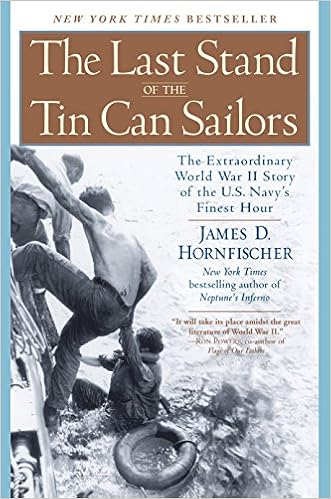
The Last Stand of the Tin Can Sailors: The Extraordinary World War II Story of the U.S. Navy's Finest Hour
“This will be a fight against overwhelming odds from which survival cannot be expected. We will do what damage we can.”
With these words, Lieutenant Commander Robert W. Copeland addressed the crew of the destroyer escort USS Samuel B. Roberts on the morning of October 25, 1944, off the Philippine Island of Samar. On the horizon loomed the mightiest ships of the Japanese navy, a massive fleet that represented the last hope of a staggering empire. All that stood between it and Douglas MacArthur’ s vulnerable invasion force were the Roberts and the other small ships of a tiny American flotilla poised to charge into history.
In the tradition of the #1 New York Times bestseller Flags of Our Fathers, James D. Hornfischer paints an unprecedented portrait of the Battle of Samar, a naval engagement unlike any other in U.S. history—and captures with unforgettable intensity the men, the strategies, and the sacrifices that turned certain defeat into a legendary victory.
Reviews (162)

"Last Stand..." is First Rate!
This is an excellent account of an often-overlooked battle in WW2. Samar is usually discussed, when it's discussed at all, only as part of the larger Battle of Leyte Gulf. Given the incredible odds faced by the ships and sailors of Taffy 3, and the unbelievable manner in which they prosecuted their attack (especially the DDs and DEs), the Battle off Samar deserves it's own, separate narrative. Hornfischer delivers in spades. The book reads almost like an historical novel, well-written, with a tension-building backstory, detailed but not too detailed descriptions of the machinery of naval war, and strong character development that makes you care about the individuals involved as persons and not just names from history. The author's ability to draw you into the lives of the ships and the men on them will put you on the edge of your seat as you read the battle narrative, and may well break the reader's heart as they read of the tremendously brutal cost these men paid. A nice added touch: I bought "Last Stand..." as a Kindle book, and the maps would not only enlarge for viewing on the device, but also included links to print them out at home. As a map nerd I really appreciated this, and hope it becomes the norm for any book of military history. This is one of my favorite books on the war in the Pacific. I've read it 3 times now, and probably will again. HIGHLY recommended for anyone who is interested in military history.

Very Compelling and Powerful Read!
I pretty much read this book from cover to cover. Then I read it again. This book will be a go to book for years to come seeking inspiration for my writing of military Science Fiction. Uncommon bravery was common in those fateful hours as Task Force Taffy 3 fought against overwhelming odds to win the day at great sacrifice. They faced down a Japanese battleship task force including the 18 inch guns of the Yamato with only torpedo’s, five inch guns and anti-aircraft guns. The stories will stun you into shocked silence at the bravery of every member of that task force. Patton said, “It is foolish and wrong to mourn the men who died. Rather we should thank God that such men lived” and you will wholeheartedly agree with that sentiment after reading this book. My only problem with the book is the same thing that I’ve found with many mainstream publishers–their pricing. When the Kindle version of the book is only 19 cents cheaper than the paperback, something is seriously wrong. This book had been on my “Buy and read list” for a long time and I’m very glad I plunked down the money for it. I did wonder what other great books I missed that were more reasonably priced because I bought this one.

A Gripping Tale of the Largest Naval Engagement
My father and three of his brothers served in the Navy in WWII. Why there were so many farm boiys in the blue water Navy is a mystery to me but these Iowa boys all went into the Navy - 2 of them BEFORE Pearl Harbor. My father was on a minesweeper as a medic. The other brothers served on various ships in the Pacific. Fortunately, none of them were killed or maimed in battle but it was a desperate time for the USA. This extraordinary account of the Battle of Leyte Gulf (with a special focus on the DDs and DEs) is the best account I've read. It's not a view from 35,000 ft; this account takes you deckside and below as smaller ships led by daring and resourceful men stopped a superior surface fleet. This is a book you'll just have to read 'one more chapter' before you hit the sack. There have been books written focusing on strategies, judgement errors on both sides and the hand that luck (good or bad) plays out. This account puts you at the various scenes - you can smell the aftermath of big guns being fired, you can sense the desperation of being attacked by bigger ships, you can see and smell the battle damage including the carnage of many involved and you are once more reminded of the incalculable debt we owe these men.

A ripping yarn........
I had heard of the battle of the "jeep" carriers vs. The central Japanese fleet, how the Japanese decked out Halsey to steam North after an irresistible target, the Imperial fleet's aircraft carriers. I read of the bravery, the improbable victory over a vastly superior foe, suicide destroyer charges against battleships and cruisers........ And I knew nothing. Hornfisher's recounting of the battle puts you in the middle of it: you meet the men involved, feel the fear and bravery, and experience the sheer horror of the last major battle between navies (yes, that long ago). It was horrible reading it, being there must have been ghastly. So a great read, 40 plane "mini" carriers with older planes with the help of local airstrips maneuver, attack, and pull off an amazing win, well worth it

Such Brave Men, Heroes All
And then, after having lost their ship, the tiny destroyer escort USS Samuel B. Roberts, in mortal combat against a much mightier Japanese force of heavy cruisers and battleships, the surviving heroes, cast adrift, endured the Philippine Sea for interminable days and nights, fighting off the ever-present predatory sharks, and also madness: (This, from Hornfischer, p. 384-386) "With exhaustion traveled its darker twin, delirium, It was the product of fatigue and of the creeping effects of ingested salt water, a poison that tended to have a phantasmagoric effect on the brain. [It] affected most of the men at one time or another during the second night. "For two days the men had had nothing to drink save the brackish water in the the five-gallon water breakers that the raft carried for just this purpose. But soon enough a far preferable alternative presented itself. Tom Stevenson was delighted now to discover a freshwater source that no one had seen before -- why hadn't anyone noticed it? The lieutenant became convinced that if only he could make it down to the first deck of the ship, a scuttlebutt full of cool freshwater was right there for his pleasure. Right below him: a fountain ... Right below him: a cool, clear arch of water. Its bubbling gurgle echoed in his mind. If only he could get down below, his thirst would be slaked. The ship was right down there, for chrissake, hovering there below him. 'There's water down there, fellas. I'll be back in a minute.' "Fortunately for Stevenson, he had the good manners to speak his plan aloud. Hearing the young officer's suicidal brainstorm, Bob Roberts and Lloyd Gurnett grabbed hold of his hand and tied him fast to the floater net. As the night wore on, it was clear that the mentally sound outnumbered and outlasted the delirious. All of a sudden the night was filled with the siren songs of fresh drinking water, hot coffee, native girls, and warm home cooking. Bob Roberts himself was not immune. An officer swam up to the exec, saluted, and requested 'permission to go below.' Roberts granted it and the officer swam off. As the currents propelled the survivors westward through the night, Roberts discerned a point of land that was dotted with fine homes. A gala dinner party was in progress, tuxedoed men and gloriously begowned women enjoying a high time by the sea. The delirium was not limited to the men of Copeland's raft. Dick Rohde left Moore's group and swam around looking for a hole in the sea containing lemonade. After Cronin saved him again, the radioman realized that the Philippines weren't ALL that far from India. His older brother was over there, flying supplies over the famous 'hump.' Surely his brother could save him. "Through the night most of the men had dalliances with madness. On Copeland's raft, Lloyd Gurnett removed his life jacket and said he was going down to the wardroom for a cup of coffee. Though alert shipmates snapped him momentarily to his senses, he did it again every fifteen minutes, until finally they restrained him for good with a well-knotted line length of manila line. At one point the strong and able Frank Cantrell declared in full basso profundo, 'Object ho!' Bob Copeland lifted his head with his hands. 'What is it, Cantrell?' the captain asked. "'I see a big white cottage on the beach with green shutters,' his chief quartermaster said. He took no small amount of umbrage to the derisive laughter that greeted his announcement. "But there were just as many men whose derangement arrived without announcement. When they decided to leave the raft in the dark of night without any word to friends, no one knew to intervene, and they were never seen again."

it's a good read once you get past the introduction of who ...
The first one forth of the book is about people that were at Leyte Gulf. But you have no idea how they fit into the story until later. The battle is incredibly interesting and well written. The last one forth is an endless story about swimming after the ships have sunk and sharks. Far too much on that part of the story. The last of the book tells what happened to the folks after the war. Overall, I gave it 4 stars. If the Leyte Gulf battle is of interest to you, it's a good read once you get past the introduction of who is who.

You can smell the cordite...
In October of 1944, the Japanese threw the remainder of their naval power into an attempt to destroy MacArthur’s invasion of the Philippines, particularly the landing on Leyte. In a three-pronged desperate operation called Sho-1, employing powerful naval task forces under the command of admirals Nishimura, Kurita, Shima, and Ozawa, the Japanese sought to stall the American island-hopping advance. While Ozawa martialed Japan’s remaining fleet carriers in hopes of drawing Halsey’s Third Fleet north, away from its position blocking the San Bernadino Strait, the other three Japanese forces would advance on Leyte in a pincer movement from north and south. When Halsey took the bait and left his assigned station to chase north after Ozawa, the only thing standing between the massively powerful Japanese fleet and the Leyte landings was Taffy 3 (Task Unit 77.4.3) consisting of 6 light carriers, three destroyers and four destroyer-escorts, under the command of Admiral Sprague. Hornfischer’s fascinating book details the heroic stand of Taffy 3, which faced the largest battleship in the world whose 18” guns had a range of 20 miles, plus three more battleships armed with 14” guns, six heavy cruisers with 8” rifles, two light cruisers, and eleven destroyers. The 5” guns on Taffy 3’s small force had a range of only about 7 miles, and their shells were insufficient to put even a dent in the armored sides of the Japanese battleships and heavy cruisers. And yet Taffy 3 slowed the Japanese onslaught, and eventually caused Admiral Kurita to lose his nerve and withdraw. The author does a superb job of introducing the reader to the human combatants, from cook to admiral, primarily on the American side. The book is full of riveting first-person accounts of the fear and courage of the men of Taffy 3, sailors and airmen, as they faced the devastating punishment of an opponent that overmatched them in every category except courage. Hornfischer points out it was a battle of firsts and lasts: first time in history that an aircraft carrier was sunk by a surface fleet, and the last time this sort of surface melee involving battleships ever happened. His writing is superb: you can feel the spray and the concussion from the Japanese shells as they straddle the ships of Taffy 3. If you enjoy military history, this is a must read. Five stars, highly recommended.

It's a Hornfischer book on Pacific naval history, d.rop the mike.
Headline says it all, if you are remotely a military history buff, a naval buff, a history buff, or all in between, or all of the above, this guy is a must read. He covers the over all portion, and infuses it with individual stories to create a true picture. Honestly, it rare I would give any author this kind of credit but he covers all bases and writes a cannot stop read book. If you haven't read him, he's a must for any military history reader. For starters this is a true triumph of David and Goliath, Alamo, and a modern last stand if the 300. Just read it and prove me wrong

so I try to read history books pretty often. But the problem I often have
I am a bit of a history buff, so I try to read history books pretty often. But the problem I often have, especially with books on military history, is that they tend to be kind of dry. A lot of talk about troop movements that I have a hard time envisioning in my head - like I need to have an interactive map right in front of me all the time if I'm going to make heads or tails of it. Plus discussion of military vehicles, and this or that caliber weapon... All kind of gets pretty boring to me. I want to hear about the PEOPLE. And that's exactly what this book gives you. I was a little worried in the first few chapters. While they had interesting stories in there, there were still hints of your typical military history book. But then the battle came. A blow by blow, chapter by chapter description of the Battle off Samar, detailing what was going on on each of the ships and with the individual sailors involved. You become well acquainted with several of the individuals involved. To be honest this is the first military history book I've ever read where when I finished one chapter I had a hard time putting the book down - I wanted to read just a bit more to see what happened to these men. Of course the battle makes for an interesting story all on its own, but I wish all history books could be this exciting.

A Battle I never was aware of until this book was read...I REALLY ENJOYED THE BOOK.
At first before I committed to buying the book (Kindle) I was a bit reluctant, but I had it in my "to read" bucket list for over a year. I was really intrigued by this story Battle off Samar, I never knew about. This was an amazing event that is tucked away in a small corner of WW2 stories. an absolutely courageous string of events that truly are heroic in my mind. I did enjoy the epilogue outlining what happened to some of the men after the battle, recovery, wounds heeled and back home stateside. To me this is important to know what happened after these men finished there duties and went home to try and get back to normalcy. I have read several of James D. Hornfischer's books and really enjoy his writings. i do recommend this book to any WW2 buff. The only disappointment I had about this book was, there is not one picture of anything related to the ships, or the men that sailed them. I do enjoy seeing some pictures during a read.


Comments
Post a Comment